ขับเคลื่อนโดย Blogger.
แสดงบทความที่มีป้ายกำกับ iPhone 6 แสดงบทความทั้งหมด

Apple's Manufacturing Partner Starts Preparing for iPhone 6 Production

วันอังคารที่ 18 มีนาคม พ.ศ. 2557

Apple supplier Pegatron is expected to start production on the iPhone 6 in the second quarter of this year at its new Kunshan, China plant, reports the Commercial Times [Google Translate].

Pegatron is already opening up a new factory space and recruiting workers in China in an effort to meet orders to manufacture the new phone, says Reuters. In early January, it was reported that Pegatron was expected to win a new contract to manufacture half of the iPhone 6's supplies. Previously, Pegatron was responsible for assembling the iPad mini and iPhone 5c, while Apple's main supplier, Foxconn, assembled many of the iPhone 5s units.

While the newspaper reported production would start ramping up in the second quarter, it did not report when the phone could come out, how many units Pegatron would manufacture, or how many workers the company was hiring. However, they do note that fellow Apple supplier Hon Hai would be the other primary manufacturer of the phone.

In 2013 Apple shifted iPhone 5c production to Pegatron in order to improve supply chain risk management, allowing Apple to expand its supply lines and minimize risk of potential supply chain disasters.

The iPhone 6 has been rumored to launch with two different versions of the phone, one with a 4.7-inch display and one with a 5.7-inch display. While there is no rumored release timeframe for the device, Apple typically releases its new iPhone models in the fall.

credit : https://googledrive.com/host/0B7NKAY5rSqLJbzE1Q3NiaUQzc00
credit : https://googledrive.com/host/0B7NKAY5rSqLJNXI2cDZLUEREdGM
credit : https://googledrive.com/host/0B7NKAY5rSqLJcE1vU0dOeG9sdHM
credit : https://googledrive.com/host/0B7NKAY5rSqLJRFNvbzhoaTZyMHc
credit : https://googledrive.com/host/0B7NKAY5rSqLJVW9jc2YxcFZ3X28

iPhone 6 May Include Temperature, Pressure and Humidity Sensors

วันจันทร์ที่ 17 มีนาคม พ.ศ. 2557

Electronics analyst Sun Chang Xu reports on her Weibo account that the next iPhone may add a pressure, temperature and humidity sensor.

G for Games relayed the report and points out that the "pressure" in this context is certainly atmospheric, not blood pressure:
According to Sun Chang Xu (news chief analyst at ESM-China), sources close to the matter have revealed that Apple will catch up in the “sensors department”, as the iPhone 6 will feature pressure, temperature and humidity sensors. Please note that the analyst is probably not referring to blood pressure (this feature is rumored to be implemented in Apple’s iWatch) but to atmospheric pressure.
This same analyst previously reported that Apple may use "optical sensors" to measure heart rate and oxygen levels in the rumored iWatch. The addition of these atmospheric sensors would bring it up in line with Samsung's S4 which included similar atmospheric sensors.

The addition of more sensors to the iPhone 6 seems a natural progression with all the recent reports that Apple has been aggressively hiring individuals in the area of health sensors. iOS 8 is said to include a Healthbook app which reports on many health related sensors.

credit : googledrive.com/host/0B7NKAY5rSqLJMjU3Z29Id2wtNnc
credit : googledrive.com/host/0B7NKAY5rSqLJUGNEMUhjVlVwa0k
credit : googledrive.com/host/0B7NKAY5rSqLJSkd6RHRDU0ZrY28
credit : googledrive.com/host/0B7NKAY5rSqLJQUk4TmVITmlsakk
credit : googledrive.com/host/0B7NKAY5rSqLJSms1NWZRWWd4Qms
credit : googledrive.com/host/0B7NKAY5rSqLJNDJHNGNXSkZ3T1U

Hope for Optical Image Stabilization in iPhone 6 Revived with Supplier Rumors

Late last week, shares of InvenSense rose on rumors that the company had won a contract to supply sensors for Apple's upcoming iPhone 6. InvenSense supplies sensors such as accelerometers and gyroscopes to major phone manufacturers, but the company has yet to publicly land a deal with Apple. The validity of the rumor seems up for debate, however, as a Needham & Company analyst soon released a note saying that he "did not get the impression" from InvenSense's CEO and CFO that such an agreement was in place. Of course, that information would be under a strict non-disclosure agreement with Apple, severely limiting what InvenSense executives could tell the analyst.

Regardless, The Motley Fool speculates on what InvenSense could bring to Apple. While InvenSense could offer drop-in replacements for the current gyroscope and accelerometer sensors in the iPhone, the company also provides Optical Image Stabilization (OIS) technology for mobile phones:
There's one additional socket that InvenSense could win on the iPhone -- an OIS gyroscope. The burgeoning technology is used to improve smartphone camera's by stabilizing the image using a gyroscope. Samsung neglected to use the technology in the Galaxy S5, but Apple may decide to integrate it into the iPhone 6. If it does, InvenSense is a clear choice.
invensense
Image from Electronics 360

Optical Image Stabilization remains relatively new in the smartphone market, and uses a motion-tracking system to compensate for device shakiness, allowing for sharper photos and video. This video demonstrates the product:

Apple presently offers software-based image stabilization in its iPhone 5s, but has definitely been researching optical image stabilization for the iPhone. Earlier this year, an Apple patent application detailing an OIS system was published. The employee who authored that patent was hired by Apple in 2012 from a company working on the same optical image stabilization technology.

Whether or not Apple is actually planning on incorporating Optical Image Stabilization technology in the next iPhone or not, it's clear the company's engineers are working on it. Historically, Apple has made steady improvements to the iPhone camera with each subsequent generation, and the last several generations have focused on image quality improvements rather than simply increasing megapixel counts.

Larger iPhone 6 May Cause Massive Spike in Upgrades, Lure Android Users


Apple's upcoming iPhone 6 is widely rumored to include a larger display, which could encourage a significant number of users to upgrade in 2014, according to analyst Brian Marshall of ISI Group, who released a note to investors today.

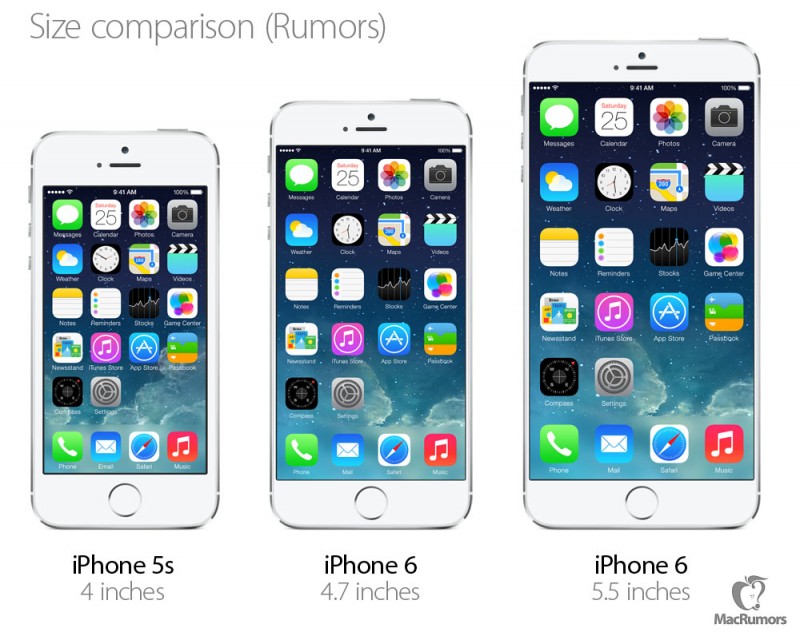
Echoing past iPhone 6 rumors, Marshall suggests Apple will release two versions of the phone, one with a 4.7-inch screen and one with a 5.5-inch screen. The launch of two phones, both of which offer a total redesign of the existing 4-inch iPhone 5s, could spark a massive upgrade cycle.

iphone6-sizes
Apple's current installed base is estimated to be at 260 million users, and ISI Group calculates that half of today's iPhone purchases are made by upgraders, users who are upgrading their iPhones from an existing iPhone to a new version of the product.

ISI indicates that while the upgrade rate (percentage of installed base upgrading devices in a given quarter) was at 10 to 11 percent in 2011–2012, it has now dropped to approximately 9 percent because users have fewer reasons to upgrade with the iPhone 5c and 5s not introducing any significant design changes.

iphone6upgrades
Peak quarters have seen upgrade rates of 12 to 14 percent, and ISI expects a similar upgrade rate during the second half of 2014 when the iPhone 6 is launched, resulting in a higher number of sales. An iPhone 6 with an increased screen size may also lure customers who have switched to Android from the iPhone because of the latter's lack of a large display.
"Large-screen envy" is prevalent among the iPhone installed base and we believe a ~5” form-factor iPhone would spark a massive upgrade cycle as well as many "Android switchers" returning back to the iPhone (we refer to this as the “mother lode” of all Apple upgrade cycles).
Citing both "large-screen envy" and "pent-up demand" ISI Group suggests the new iPhone 6 models could result in an extra $3.00 earnings per share following release in the second half of 2014.

Higher demand for an iPhone during a redesign year is not unreasonable, as it has now been two years since the 2012 introduction of the iPhone 5. While the iPhone 5s included multiple internal improvements and the Touch ID fingerprint sensor, it retained the same 4-inch display and design of the iPhone 5, as did the iPhone 5c, which was just a repackaging of the existing model.

credit : googledrive.com/host/0B7NKAY5rSqLJMjU3Z29Id2wtNnc
credit : googledrive.com/host/0B7NKAY5rSqLJUGNEMUhjVlVwa0k
credit : googledrive.com/host/0B7NKAY5rSqLJSkd6RHRDU0ZrY28
credit : googledrive.com/host/0B7NKAY5rSqLJQUk4TmVITmlsakk
credit : googledrive.com/host/0B7NKAY5rSqLJSms1NWZRWWd4Qms
credit : googledrive.com/host/0B7NKAY5rSqLJNDJHNGNXSkZ3T1U

What should we expect from Apple in 2014? iWatch, iPhone 6, iPad Pro?

วันศุกร์ที่ 3 มกราคม พ.ศ. 2557

What should we expect from Apple in 2014? iWatch, iPhone 6, iPad Pro?

Computers_Apple_Apple_building_028837_


2013 was a great year for Apple. Of course, analysts might have us believe otherwise, but Apple sold an incredible number of phones and tablets while keeping things solid in the laptop/desktop market. Ignoring sales numbers for a second, Apple released a fantastic range of new products. Perhaps its best yet. Earlier in the year we saw the new, faster MacBook Air which many tech reviewers agree is the best laptop ever made. iOS 7 marked a change in direction for the iPhone and iPad’s operating system, ditching skeuomorphic design and textures with flatness, light font and bright colors. iOS 7 was re-engineered under the hood to give app developers much more to play with including background app refreshing and the ability to hook up physical gamepads. We also saw the awesome iPad Air and the breathtaking Mac Pro.
All in all, if I was to round up my feelings on last year, it’s that it was a prelude to a new phase of product design and innovation. Including a 64-bit chip inside the new iDevices shows us that Apple is thinking big for future mobile computing. Touch ID shows us that the company wants to kick-start a more secure environment for its users. Mac Pro shows that Apple still knows how to innovate at an astonishing level. This is the professional workstation for years to come.
I guess the biggest disappointment of the year (or two of them) was : rumors/leaks and analysts. Before the new iPhones and iPads were announced, we knew exactly what to expect thanks to some accurate and frequent leaks and rumors. Also, analysts throughout the year kept on telling Apple what it needed to do to “succeed”. The problem here is that so many analysts have a faulty scale of success. For them, it’s all about stock value and market share. Apple’s more interested in making great, profitable products. Apple sold loads, and made a lot of money. Its profits still made up the vast majority of the smartphone industry, with only Samsung making any significant profits and that mostly from low-end smartphones. Most other manufacturers struggled to make profit, many (including HTC and BlackBerry) lost millions.
But what does the next year hold for Apple?
One thing that’s certain about Apple is that it has a single-minded focus on what it wants to achieve. It’s not a company easily swayed by the movements of other manufacturers, or by Wall Street performance. As Carl Icahn has also found in recent weeks, it’s also not easily persuaded by anyone, regardless of how much they’ve invested in the company. Some may see this as arrogance, pride or stubbornness. I see it as necessary. Panic releasing “innovative” products isn’t enough. A steady improvement is a much better tactic.

iPhone 6

iPhone 6 concept by iPhoneSoft.fr
Please let it have a bigger screen! It’s the one feature tech enthusiasts have been demanding for ages. Apple appeased them slightly with the iPhone 5 in 2012, making the screen longer. One thing I think we can be sure of with this year’s new iPhone is that it’ll have a new design. For almost as long as the iPhone’s existed, they’ve released a new form factor every two years. We had 3G/3GS, 4/4S and 5/5s/5c. I can’t even begin to predict what the phone might feature different from the current crop of iPhones, but it’ll almost certainly have a very familiar front face. Touch ID is here to stay, which means the home button is here to stay.
Apple’s biggest challenge with creating a larger screen is deciding on a resolution. It can’t go with industry standard 720p or 1080p panels. It’d make it more difficult than necessary for developers to optimized their apps for the new screen and resolution. Perhaps the screen would only be slightly larger and have exactly the same resolution as the iPhone 5s/5c, but feature a slightly lower pixel density. For instance, if the same 1136×640 pixels graced a 4.5-inch panel, it’d have a density of around 290ppi, which Apple could still argue was a Retina display.
My biggest question for the iPhone 6 is whether there’ll be two versions. With iPhone 5s and 5c we got one premium, glass and metal device and one more playful and colorful device. Both are fantastic and offer something different. Will the iPhone 6 have a plastic, colorful sibling? Who knows. If it does, it would see Apple have 4 different iPhones on the market at the same time. I cannot for one second imagine that Apple would get rid of the iPhone 5c or 5s after just 12 months.
One thing is for sure, Apple has to kill of the 30-pin connector for good, which means the 4s is a certain casualty of 2014.

iOS 8

iOS 8 will almost certainly be unveiled at WWDC in June this year. What it’ll feature, I can’t even guess. I could list all the things I’d like it to have, but they’d be the same bunch of features I’ve been wanting for years: Better Notifications, better multitasking etc.. One thing we won’t see is a drastic change in user interface.
Where we will see change is under the hood and in the list of APIs available to developers. Perhaps one of those will be an ability for certain apps to make use of Touch ID. The key here – again – is security. Apple’s engineers will need to make an API available that allows temporary access to the fingerprint data secured inside the A7’s secure enclave. Even Apple itself doesn’t store or have access to that data, but it could come in incredibly useful in particular apps such as mobile banking, password/locker/wallet apps. One thing is certain: Apple did not spend a lot of time, money and energy to develop an awesome fingerprint scanner purely for unlocking your phone or allowing iTunes purchases. It will go much deeper than that, and will make its way across the entire iOS device range eventually, including iPads.

iPad

iPad Pro concept
iPad Pro concept by MacRumors
Although we’ve seen rumors of a larger iPad Pro, I expect the iPad lineup to be the one that sees the least change in 2014. iPad Air just got released and will likely be the flagship tablet for the next couple of years. Although its design will likely remain, you can expect the internal components to be upgraded in line with the new iPhone and operating system. If I’m 100% completely honest, I don’t think I’d mind that much if the iPad range wasn’t updated at all this year. It’s hard to see how either the Retina iPad mini or iPad Air can be improved (apart from adding Touch ID and a new processor).

Breaking new ground?

iWatch concept
iWatch concept
The big question, or biggest question, for Apple in 2013 is whether or not it’s going to venture in to unfamiliar territory. Will we see anything new and innovative from Apple? We’ve been waiting since 2010, and it feels about time. It’d also be the first time it will have done so since Steve Jobs passed away, and prove the “this wouldn’t happen under Jobs” crowd wrong. If it does break new ground, where will it do so?
The biggest expectation for most of us is that Apple will make a smartwatch at some point soon. Or – at least – some form of wearable technology. If there is an iWatch on the horizon, the best way to predict what it’s going to feature is to try and remember Apple’s way of working, its mentality and focus. It’s not going to try and compete spec-for-spec with Samsung’s ridiculous Galaxy Gear.
Firstly, it’s got to be different. The iMac was different to every other PC on the market, the iPod was different to the MP3 players of the day, as were iPhone and iPad in their respective markets. It’s why I find it hard to imagine than an iWatch will have a traditional watch design. It has to be a trend-setter and that means it needs to be instantly recognizable. Traditionally, Apple likes to focus on making things really easy and getting them to “magically” “just work”. You’d expect that it might hook up with your iPhone to show you important notifications, access Siri and tell the time as well as track your movements and help keep you fit. In my mind, it’ll be functions from the Pebble and Nike Fuelband but in to something that looks like it was designed by a team up of Rolls Royce and Armani. Really, this is all just guessing.
As for the elusive TV set, I don’t see it. I have no real reason except that the market is very well established, and breaking in to it with any significant impact will take something affordable and incredible.

Leadership

Apple’s spent the past few months acquiring talent to join its executive team including Burberry’s former CEO as head of retail, a couple of guys from the Nike design studios and – more recently – a former NYT design director. Although there’s clear change with a focus on innovation and design, we’ll also have had a full 12 months with Craig Federighi and Sir Jony Ive working collaboratively together to enhance software and hardware on both the Mac and iOS side. Jony has an incredibly eye for industrial design and manufacturing processes, while Craig has enthusiasm and an almost child-like charm when he presents on stage.

“Apple is Doomed” Stories

They won’t go away. Because they make good traffic, even if completely unfounded and based on the misinterpretation of unimportant metrics.

Wrap-up

china-mobile-building
Leaks from the supply chain are getting harder and harder to stop, so the chances that Apple will surprise us with the iPhone and iPad updates this year are slim. We’ll more than likely start seeing hardware leaks in the next few months, with more and more parts and rumors accelerating to a crescendo in the latter half of 2014.
One thing that is worth watching is the smartphone industry as a whole. It’s almost completely saturated now in the West. Both tablet and smartphone markets are growing exponentially in developing countries like China, India and Brazil. But, those countries are mostly seeing sales of devices below $400. As we know, Apple’s not interested in that sector of the market. That said, if other manufacturers keep on losing money the way they are, it’ll leave only Apple and Samsung to battle it out. Something has to give soon. BlackBerry is only just hanging on for dear life and HTC is struggling. Motorola and Nokia’s futures were secured – for the time being – by being swallowed up by software companies (Google and Microsoft). It makes you worry that those who haven’t might not make it much longer than 12-24 months.
All in all, Apple should have another solid year. With the China Mobile deal finally wrapped up, Apple’s iPhone sales will continue to grow, as will profits, and we know the leadership is keen to keep on innovating as if it’s trying to make its way out of near-brankruptcy, even though its financial situation is about as far as possible from the precarious days of the late 1990s. I’m looking forward to 2014 more than any other year previous, and can’t wait to see if Cupertino will surprise us.

. . . . . . . . . . . . . . . . . . . . . . . . . . . . . . . . . . . . . . . . . . . . . . . . . . . . . . . . . . . . . . . . . . . . . . . . . . . . . . . . . . . . . . . . . . . . . . . . . . . . . . . . . . . . . . . . . . . . . . . . . . . . . . . . . . . . . . . . . . . . . . . . . . . . . . . . . . . . . . . . . . . . . . . . . . . . . . . . . . . . . . . . . . . . . . . . . . . . . . . . . . . . . . . . . . . . . . . . . . . . . . . . . . . . . . . . . . . . . . . . . . . . . . . . . . . . . . . . . . . . . . . . . . . . . . . . . . . . . . . . . . . . . . . . . . . . . . . . . . . . . . . . . .

Paint-by-rumors: Expectations for Apple in 2014

Paint-by-rumors: Expectations for Apple in 2014


Despite refreshes or redesigns for almost every product under Apple's umbrella in 2013, even more excitement is expected from Cupertino in 2014 with rumors pointing toward potential forays into television sets and wearable devices alongside larger displays for iPhones and iPads.

Mac Shuffle
Image courtesy of Flickr user boltron.


During Apple's quarterly results call last April, CEO Tim Cook promised that the company had "a lot more surprises in the works" that would come to light in "the fall [of 2013] and all of 2014." What seemed at the time like a line designed to reassure investors following Apple's first year-over-year earnings decline in over a decade has, instead, proved prophetic.

Last fall brought a flurry of releases from Cupertino, including a second new iPhone model for the first time ever, a radical redesign for the venerable Mac Pro, the ultra-thin and light iPad Air, new Haswell-based MacBook Pros, a Retina display-equipped iPad mini, the 64-bit A7 processor, biometric security with Touch ID, a new iWork suite, and the revelation that OS X Mavericks would be offered for free.

Only the MacBook Air and Mac Mini survived autumn without so much as a tweak. With those recent eye-openers in mind, here is what the rumor mill has in store for Apple this year:

iWatch

Wearable Device
Wearable Device
AppleInsider was first to discover an Apple patent filing describing a watch design with flexible display.


Whispers of an Apple-branded smart watch began surfacing in earnest just over one year ago with a report that Apple and Intel were collaborating on such a device. The so-called "iWatch" was a no-show in 2013, and the public's furor for the wrist-worn gadget has only intensified in the interim. 

Most accounts agree that the iWatch will sport an OLED display, though some believe it will instead feature touchscreen technology similar to that found on the current-generation iPod nano. In either case, the display's size is expected to be between 1.5 and 2 inches on the diagonal.

Well-connected analyst Ming-Chi Kuo of KGI Securities, one of the most reliable predictors of Apple's future products, believes the iWatch will contain advanced biometric capabilities — an assertion backed up by Apple's recent hiring of experts in the field of non-intrusive medical sensors — and function as a standalone device. Most others see the iWatch as a companion to Apple's iOS devices in the same vein as Samsung's Galaxy Gear. 

Apple is believed to have a team of more than 100 working on the iWatch and has brought in some heavyweight industry veterans for the project. Paul Deneve, former CEO of French fashion house Yves Saint Laurent, Nike FuelBand consultant and fitness expert Jay Blahnik, and Nike design director Ben Shaffer have all made moves to Cupertino in recent months and are thought to be involved with Apple's wearable.

More concrete evidence of the project's existence turned up in a string of "iWatch" trademark filings attributed to Apple in Mexico, Taiwan, Russia, and Japan last summer. 

If Apple does eventually ship the iWatch, most believe it will make its debut in the latter half of 2014. Analysts have predicted that Apple could move up to 65 million devices in its first year.

iPhone 6

iPhone Plus
iPhone Plus
Mockup of iPhone with 4.94-inch screen, created by Marco Arment.


Thanks to Apple's predictable iPhone refresh cycle, gossip of what next year's device will bring often begins before the ink on this year's promotional posters is dry. The so-called "iPhone 6" is no exception. 

The focus of most rumors swirling around Apple's next-generation handset is the device's display. Analysts are almost unanimous in their belief that the iPhone 6 will come with a larger screen, but the display's exact size and type are the subjects of much debate. 

Many think the upcoming revision will be the time when Apple finally embraces OLED displays for the iPhone, but Cook threw cold water on that fire last February when he panned the technology's color reproduction capability. He did, however, leave open the possibility of a larger LCD. 

Most speculation centers on an increase to between 4.5 and 5.5 inches from the iPhone's current 4-inch diagonal measurement. Kuo, the aforementioned Apple prognosticator, believes the 4.5-inch end of the range is more likely due to Apple's "unwavering principle of one-hand use."

Apple is also said to be exploring curved glass displays that could wrap around the device's edges, as well as the addition of new pressure-sensitive layers. 

No matter the final form factor, a next-generation A-series processor — likely the A8 — is predicted to power the device that should be released next fall. 

iPad Pro

iPad Air
iPad Air
The iPad Air is currently Apple's largest tablet with a 9.7-inch display.


Compared to other potential Apple products, little speculation surrounds the so-called "iPad Pro." The plus-sized tablet is expected to sport an ultra-high-definition 12.9-inch display, but no other details have emerged even as whispers have appeared in outlets like the Wall Street Journal.

Some say longtime Apple supplier Quanta Computer has been tabbed as Cupertino's assembly partner for the device, and a "first-tier display supplier" out of Korea is believed to have begun readying production lines for the iPad Pro's display. Others have pegged Quanta's rival Taiwanese contract manufacturer Foxconn for the assembly role.

Like the iWatch and iPhone 6, the iPad Pro is said to be slated for release in the second half of 2014.

iTV

Apple TV
Apple TV


Rumbles of an Apple-branded television set have been all over the map for nearly a decade, and they only grew stronger after late Apple founder Steve Jobs was quoted in his biography as saying he had "finally cracked" the concept. "It will have the simplest user interface you could imagine," he is said to have told biographer Walter Isaacson. 

Many now believe that rather than attempting to break into the relatively low-margin television hardware business, Apple will make their move in the form of a set-top box similar to the existing Apple TV. In this way, the company can focus on areas of strength, namely content and user experience, while relegating the set itself to a "dumb" display. 

To facilitate this strategy, the company has reportedly begun engaging directly with content owners like ESPN, HBO, and Viacom, bypassing traditional cable companies. One report even suggests that Apple may be prepared to become a virtual cable company itself. 

Apple's acquisition of PrimeSense, an Israeli startup that made the technology behind Microsoft's first-generation Kinect sensor, late last year has fueled speculation that future Apple TV units could make use of gesture and voice controls rather than hardware remotes or iOS-based remote applications. Apple could also keep the hardware remote option available for a future Apple TV app store that would bring iOS-style apps to users' televisions. 

One industry analyst believes that while Apple was planning to launch a television set in the second half of 2014, those plans have been temporarily shelved in favor of the iWatch initiative.

. . . . . . . . . . . . . . . . . . . . . . . . . . . . . . . . . . . . . . . . . . . . . . . . . . . . . . . . . . . . . . . . . . . . . . . . . . . . . . . . . . . . . . . . . . . . . . . . . . . . . . . . . . . . . . . . . . . . . . . . . . . . . . . . . . . . . . . . . . . . . . . . . . . . . . . . . . . . . . . . . . . . . . . . . . . . . . . . . . . . . . . . . . . . . . . . . . . . . . . . . . . . . . . . . . . . . . . . . . . . . . . . . . . . . . . . . . . . . . . . . . . . . . . . . . . . . . . . . . . . . . . . . . . . . . . . . . . . . . . . . . . . . . . . . . . . . . . . . . . . . . . . . .

Rumor: Apple to release iPhone 6 May 2014

วันพฤหัสบดีที่ 2 มกราคม พ.ศ. 2557

Rumor: Apple to release iPhone 6 May 2014 

iPhoen 6 concept developed by ADR Studio.


This past Sunday, the curtain was lifted on a deal struck between Apple and the world’s largest phone carrier, China Mobile. The focus of the deal is to make both the iPhone 5s and iPhone 5c available to the company’s 760 million subscribers as soon as January 17, 2014. Having already sold 23 million iPhones over this past year in China, analysts project Apple doubling their reach having penned the deal with China Mobile.

As always, a new deal and a new year brings next-gen iPhone speculation and it would seem the rumor mill has already begun churning. Digitimes claims “sources from the upstream supply chain” indicate Apple will release a large 5-inch iPhone (iPhone 6?) in May 2014 and a large 12.9-inch iPad (iPad Max?) in October 2014. As smartphone screen sizes have gotten progressively larger over the years, Apple has (in true Apple fashion) been slow to make evolutionary changes to the iPhone. This changed with the iPhone 5, when the company lengthened the phone, increasing the screen size disproportionately. However, other manufacturers continue to dominate the “phablet” market, such as Samsung with the wildly successful Galaxy S4 and Note II. As Forbes alludes, the new iPhone model will prove beneficial for iPhone 5c, which was touted as a lower cost iPhone, as it will push its price lower and make it more accessible to consumers, in say, China.

Is Apple throttling potential profits from the iPhone 5s by releasing a new model so soon? In the past, Apple has released a new iPhone each year late summer or early autumn. The iPhone 5s hit shelves just this past summer, and if the May 2014 rumor is accurate, the company has never launched two iPhones so close together (with exception of the iPhone 5c and iPhone 5s). Some speculate Apple may being pushing out newer phones sooner in an effort to keep up with the rapid evolution and release cycle of Android-based smartphones.

. . . . . . . . . . . . . . . . . . . . . . . . . . . . . . . . . . . . . . . . . . . . . . . . . . . . . . . . . . . . . . . . . . . . . . . . . . . . . . . . . . . . . . . . . . . . . . . . . . . . . . . . . . . . . . . . . . . . . . . . . . . . . . . . . . . . . . . . . . . . . . . . . . . . . . . . . . . . . . . . . . . . . . . . . . . . . . . . . . . . . . . . . . . . . . . . . . . . . . . . . . . . . . . . . . . . . . . . . . . . . . . . . . . . . . . . . . . . . . . . . . . . . . . . . . . . . . . . . . . . . . . . . . . . . . . . . . . . . . . . . . . . . . . . . . . . . . . . . . . . . . . . . . . . . . . . . . . . . . . . . . . . . . . . . . . . . . . . . . . . . . . . . . . . . . . . . . . . . . . . . . . . . . . . . . . . . . . . . . . . . . . . . . . . . . . . . . . . . . . . . . . . . . . . . . . . . . . . . . . . . . . . . . . . . . . . . . . . . . . . . . . . . . . . . . . . . . . . . . . . . . . . . . . . . . . . . . . . . . . . . . . . . . . . . . . . . . . . . . . . . . . . . . . . . . . . . . . . . . . . . . . . . . . . . . . . . . . . . . . . . . . . . . . . . . . . . . . . . . . . . . . . . . . . . . . . . . . . . . . . . . . . . . . . . . . . . . . . . . . . . . . . . . . . . . . . . . . .


Translate

Most Reading

Tags