ขับเคลื่อนโดย Blogger.
แสดงบทความที่มีป้ายกำกับ iWatch แสดงบทความทั้งหมด

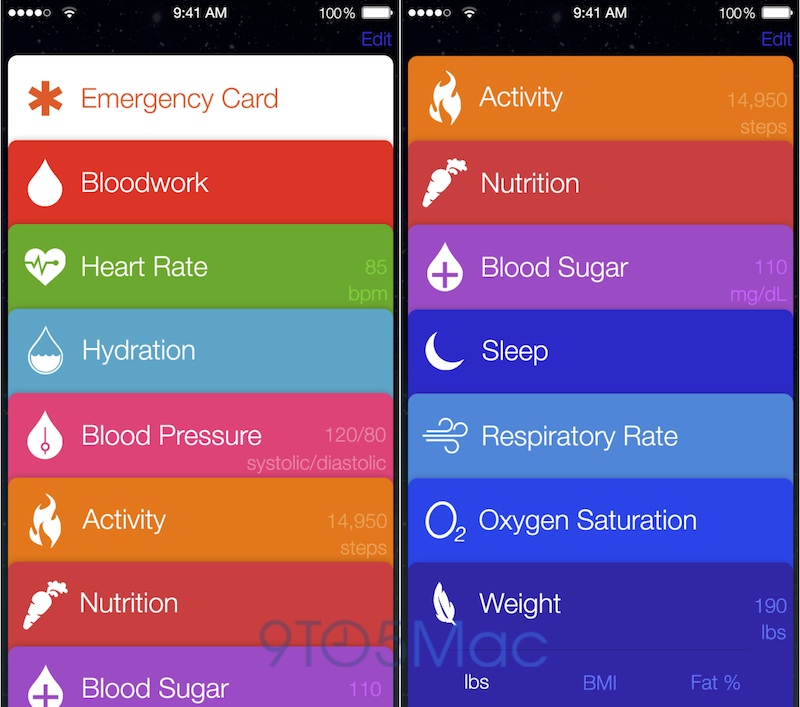
Apple's Healthbook App for iOS Shown in Renderings with New Details

วันจันทร์ที่ 17 มีนาคม พ.ศ. 2557

Apple's rumored "Healthbook" app for iOS 8 may be the company's first big push into the current health and fitness craze that is being fueled by wearable technology, and a new report from 9to5Mac offers a look at what users can expect from the app as well as a few renderings of the app said to be recreated from actual screenshots.

healthbook_rendering
The renderings show a Passbook-inspired user interface with cards for different heath and fitness data points, with the app able to keep track of vitals mentioned in previous rumors such as heart rate, hydration, blood pressure, physical activity and more. Notably missing from the renders are parameters for other topic such as stress and pregnancy tracking, which had been suggested in a separate report from MobiHealthNews last month.
Each category of functionality is a card in the Healthbook. Cards are distinguished by a color, and the tabs can be arranged to fit user preferences. As can be seen in the above images, Healthbook has sections that can track data pertaining to bloodwork, heart rate, hydration, blood pressure, physical activity, nutrition, blood sugar, sleep, respiratory rate, oxygen saturation, and weight.
A big chunk of the Healtbook app will be dedicated to measurable health parameters such as blood sugar levels, oxygen saturation, bloodwork values and more. The blood sugar tracking would let diabetics enter their daily or weekly glucose levels and track changes over time, while the bloodwork tab would allow users to enter the results of routine bloodwork tests that are used to screen for overall nutrition as well as heart, kidney or liver disease. When combined, these parameters will provide the user and their doctor with a snapshot of the person's overall health at any given time.

Another focus of the app is fitness, with the ability to track activity levels, nutrition, and weight changes over time. Data in these tabs would provide detailed analysis of calories burned, BMI, body fat percentage and more. This section, which also includes sleep tracking and hydration measurement, provides the user with an overview of their fitness and allows them to monitor any changes over time.

The mechanisms by which the app will retrieve this health and fitness data, especially the more difficult to measure vitals such as hydration and blood sugar, are not clear, although it is likely the app will utilize some combination of the iPhone's M7 motion coprocessor, third-party devices, third-party apps and Apple's own wearable devices such as the rumored iWatch.
Thanks to the capabilities of the iPhone 5s’s M7 motion co-processor, Healthbook could technically receive steps, miles walked, and caloric data from the iPhone itself. However, that is where the M7 stops being useful for Healthbook. Blood, hydration, and respiratory rate information would clearly need to come from other sources.
Apple has been hiring health and fitness experts to build out its iWatch team, and is rumored to be using this expertise in the development of its first wearable device. The iWatch is rumored to launch later this year, and Healthbook should debut as part of iOS 8 in a similar timeframe late this year.

Apple's iPod Nano Pedometer Patent Application Sparks iWatch Speculation

วันศุกร์ที่ 14 มีนาคม พ.ศ. 2557

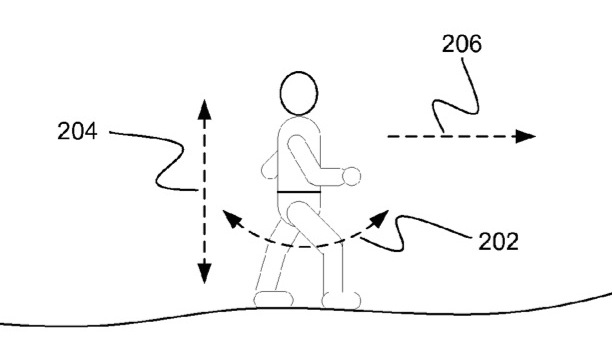
Apple has been rumored for some time to be working on an "iWatch" featuring biometric sensors and integration with other iOS devices, and a recently published patent application (via AppleInsider) addressing pedometer functions is being presented as evidence that the company is indeed working on a wrist-worn fitness device.
In some implementations, optimizations for detecting steps when a pedometer is worn at a user's wrist are described. In some implementations, a threshold crossing step detection method can be enhanced for wrist locations by counting the number of positive peaks between comparison threshold crossings, adjusting a minimum peak-to-peak threshold for qualifying threshold crossings, and inferring a second step based on the amount of time between threshold crossings. In some implementations, the pedometer can automatically determine that the pedometer is being worn on a user's wrist.
apple_wrist_pedometer-patent
The problem with this interpretation is that Apple already offers a product with a built-in pedometer and which is frequently worn on the wrist or arm: the iPod nano with Nike+ integration. Also supporting the idea that this research was pursued with the iPod in mind is the fact that the sole inventor listed on the patent, Yash Modi, is open about his work on iPod pedometer functionality during his time at the company. Modi left Apple in March 2012 to join Nest.

modi_ipod_pedometer
While such pedometer functionality is likely to make its way into the iWatch given rumors of emphasis on biometric sensors for the device, Apple's patent application is by no means a smoking gun given that the technology has been in use for a number of years already. The built-in pedometer debuted in the fifth-generation iPod nano introduced in September 2009.

Still, Apple's "Wrist Pedometer Step Detection" patent offers an interesting glimpse at how Apple has worked to optimize algorithms for detecting steps when a device is worn on the wrist. Unlike standard pedometers that are worn on the waist and provide consistent step data, the wrist adds complexity to step measurement because its motion is not always tied to actual forward movement. Algorithms analyzing wrist movement data must isolate actual steps from the background movement when users are typing, driving or performing other common tasks.

Apple's filtering method of step analysis accurately measures this movement and has the added benefit of being able to analyze movement from a device that is worn anywhere on the body. The software powering the device also can determine when a device is worn on the wrist or another body part and will adjust its analysis based on the device's location.

Apple is expected to unveil its iWatch wearable later this year with health and productivity features that connect the device to a user's iPhone or iPad via Siri and iOS 8's Healthbook app.

credit : googledrive.com/host/0B7NKAY5rSqLJOUZaVWJzeXVUVmM
credit : googledrive.com/host/0B7NKAY5rSqLJakNoMF9ESmt5ajg
credit : googledrive.com/host/0B7NKAY5rSqLJZ3ZhbXVQNHJ1am8
credit : googledrive.com/host/0B7NKAY5rSqLJUm5JMmt6MUNJZ1k
credit : googledrive.com/host/0B7NKAY5rSqLJMlBpMDZZblVlOXc
credit : googledrive.com/host/0B7NKAY5rSqLJZHpCay1xdTdhRzA

New Concepts Imagine the iWatch as a Lifestyle Device, Traditional Timepiece

วันพุธที่ 12 มีนาคม พ.ศ. 2557

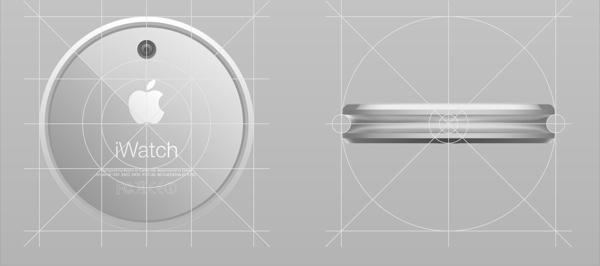
While earlier iWatch concepts were inspired by the wearable's health-tracking features, a new set of renderings from Argentine design student Tomas Moyano imagines the iWatch as a device that'll produce "a further and deeper interaction between human beings and technology."

iwatch-concept-moyano-grid
Moyano pictures a perfectly round device, with grooves in the side that'll allow for multiple looks with different bands. Similar to the Shine from Misfit Wearables, the concept design features no buttons to catch on your sleeve and no holes to allow in water or dust. Submersible and resistant to dust, the watch lacks speakers and will rely on vibration notifications to alert you to an incoming message.
Wait a moment, no speakers? Think about it. A watch is almost always on your hand, pretty far from your ears. Imagine yourself walking on a noisy city: If you want to hear a notification sound from your smartwatch, it should be a loud sound, and to produce it, it would need a lot of energy and big components. Both things not easy to include on a such small device.

Besides that the iWatch will be constantly in contact with your skin and body, an important fact to consider. That's why I decided you shouldn't hear, but feel the notifications. That is right: Vibration notifications. Perfectly submersible and dust resistant vibration notifications.
Battery life will be a challenge in such a small device, so Moyano visualizes the iWatch with micro-solar panels and wireless recharging. To conserve this precious power, the concept iWatch will sacrifice the cellular connection and associated services that require an internet connection. Moyano's concept envisions Maps working on the iWatch, but it is not clear how the maps would be usable on such a small-screened device.

iwatch-concept-moyano-wrist
Another circulating iWatch concept created by Hungarian freelance designer Gábor Balogh and published by The Verge is inspired by traditional wristwatch design. The concept uses an actual product image of the Havana timepiece from Swedish watchmaker Triwa. Balogh replaces the face of the watch with rumored iWatch features such as messages and heart rate tracking.

Balogh-iwatch
Though the iWatch may not have many of the features mentioned above, it is rumored to include biometric functions like a heart rate monitor that'll tie into Apple's iOS 8 ecosystem via a new Healthbook app. It may also ship with a version of Siri tailored for the wrist-worn device.

Apple Working to Expand Siri's Third-Party App Integration for iWatch

วันพฤหัสบดีที่ 6 มีนาคม พ.ศ. 2557


As Apple continues work on its much-rumored iWatch, the company is placing a significant focus on expanding Siri's ability to interface with third-party apps, according to a report from The Information summarized by TechCrunch.

With input methods for the iWatch limited due to the device's size, Siri's voice capabilities may be one of the best tools for Apple to leverage, and that means improving Siri's capabilities.
The report points out how the Siri of today can’t do things like book a car rental or make a hotel reservation, or use a messaging app other than Messages to send a text. The improvements to Siri would potentially enable those types of things, enabling third-party integrations that don’t require one-to-one business arrangement between Apple and the external company. Current integrations like those with OpenTable and Wolfram Alpha do involve those direct deals, which limits the pace at which new third-party powers can be added to Siri.
The report also claims that Apple is working on technology to dynamically adjust what content is being shown on a device's display, offering the example of a running app automatically being shown when the user begins jogging. The technology would obviously be useful for a device such as the iWatch with very limited display size and input capabilities.

Apple has been rumored for several years to be working on a smart watch project, with the company reportedly placing a strong focus on biometrics to include health-related data tracking for the iOS ecosystem.

credit : aemachinesports.url.ph
credit : wormholespace.com
credit : machinesport.wink.ws

Paint-by-rumors: Expectations for Apple in 2014

วันศุกร์ที่ 3 มกราคม พ.ศ. 2557

Paint-by-rumors: Expectations for Apple in 2014


Despite refreshes or redesigns for almost every product under Apple's umbrella in 2013, even more excitement is expected from Cupertino in 2014 with rumors pointing toward potential forays into television sets and wearable devices alongside larger displays for iPhones and iPads.

Mac Shuffle
Image courtesy of Flickr user boltron.


During Apple's quarterly results call last April, CEO Tim Cook promised that the company had "a lot more surprises in the works" that would come to light in "the fall [of 2013] and all of 2014." What seemed at the time like a line designed to reassure investors following Apple's first year-over-year earnings decline in over a decade has, instead, proved prophetic.

Last fall brought a flurry of releases from Cupertino, including a second new iPhone model for the first time ever, a radical redesign for the venerable Mac Pro, the ultra-thin and light iPad Air, new Haswell-based MacBook Pros, a Retina display-equipped iPad mini, the 64-bit A7 processor, biometric security with Touch ID, a new iWork suite, and the revelation that OS X Mavericks would be offered for free.

Only the MacBook Air and Mac Mini survived autumn without so much as a tweak. With those recent eye-openers in mind, here is what the rumor mill has in store for Apple this year:

iWatch

Wearable Device
Wearable Device
AppleInsider was first to discover an Apple patent filing describing a watch design with flexible display.


Whispers of an Apple-branded smart watch began surfacing in earnest just over one year ago with a report that Apple and Intel were collaborating on such a device. The so-called "iWatch" was a no-show in 2013, and the public's furor for the wrist-worn gadget has only intensified in the interim. 

Most accounts agree that the iWatch will sport an OLED display, though some believe it will instead feature touchscreen technology similar to that found on the current-generation iPod nano. In either case, the display's size is expected to be between 1.5 and 2 inches on the diagonal.

Well-connected analyst Ming-Chi Kuo of KGI Securities, one of the most reliable predictors of Apple's future products, believes the iWatch will contain advanced biometric capabilities — an assertion backed up by Apple's recent hiring of experts in the field of non-intrusive medical sensors — and function as a standalone device. Most others see the iWatch as a companion to Apple's iOS devices in the same vein as Samsung's Galaxy Gear. 

Apple is believed to have a team of more than 100 working on the iWatch and has brought in some heavyweight industry veterans for the project. Paul Deneve, former CEO of French fashion house Yves Saint Laurent, Nike FuelBand consultant and fitness expert Jay Blahnik, and Nike design director Ben Shaffer have all made moves to Cupertino in recent months and are thought to be involved with Apple's wearable.

More concrete evidence of the project's existence turned up in a string of "iWatch" trademark filings attributed to Apple in Mexico, Taiwan, Russia, and Japan last summer. 

If Apple does eventually ship the iWatch, most believe it will make its debut in the latter half of 2014. Analysts have predicted that Apple could move up to 65 million devices in its first year.

iPhone 6

iPhone Plus
iPhone Plus
Mockup of iPhone with 4.94-inch screen, created by Marco Arment.


Thanks to Apple's predictable iPhone refresh cycle, gossip of what next year's device will bring often begins before the ink on this year's promotional posters is dry. The so-called "iPhone 6" is no exception. 

The focus of most rumors swirling around Apple's next-generation handset is the device's display. Analysts are almost unanimous in their belief that the iPhone 6 will come with a larger screen, but the display's exact size and type are the subjects of much debate. 

Many think the upcoming revision will be the time when Apple finally embraces OLED displays for the iPhone, but Cook threw cold water on that fire last February when he panned the technology's color reproduction capability. He did, however, leave open the possibility of a larger LCD. 

Most speculation centers on an increase to between 4.5 and 5.5 inches from the iPhone's current 4-inch diagonal measurement. Kuo, the aforementioned Apple prognosticator, believes the 4.5-inch end of the range is more likely due to Apple's "unwavering principle of one-hand use."

Apple is also said to be exploring curved glass displays that could wrap around the device's edges, as well as the addition of new pressure-sensitive layers. 

No matter the final form factor, a next-generation A-series processor — likely the A8 — is predicted to power the device that should be released next fall. 

iPad Pro

iPad Air
iPad Air
The iPad Air is currently Apple's largest tablet with a 9.7-inch display.


Compared to other potential Apple products, little speculation surrounds the so-called "iPad Pro." The plus-sized tablet is expected to sport an ultra-high-definition 12.9-inch display, but no other details have emerged even as whispers have appeared in outlets like the Wall Street Journal.

Some say longtime Apple supplier Quanta Computer has been tabbed as Cupertino's assembly partner for the device, and a "first-tier display supplier" out of Korea is believed to have begun readying production lines for the iPad Pro's display. Others have pegged Quanta's rival Taiwanese contract manufacturer Foxconn for the assembly role.

Like the iWatch and iPhone 6, the iPad Pro is said to be slated for release in the second half of 2014.

iTV

Apple TV
Apple TV


Rumbles of an Apple-branded television set have been all over the map for nearly a decade, and they only grew stronger after late Apple founder Steve Jobs was quoted in his biography as saying he had "finally cracked" the concept. "It will have the simplest user interface you could imagine," he is said to have told biographer Walter Isaacson. 

Many now believe that rather than attempting to break into the relatively low-margin television hardware business, Apple will make their move in the form of a set-top box similar to the existing Apple TV. In this way, the company can focus on areas of strength, namely content and user experience, while relegating the set itself to a "dumb" display. 

To facilitate this strategy, the company has reportedly begun engaging directly with content owners like ESPN, HBO, and Viacom, bypassing traditional cable companies. One report even suggests that Apple may be prepared to become a virtual cable company itself. 

Apple's acquisition of PrimeSense, an Israeli startup that made the technology behind Microsoft's first-generation Kinect sensor, late last year has fueled speculation that future Apple TV units could make use of gesture and voice controls rather than hardware remotes or iOS-based remote applications. Apple could also keep the hardware remote option available for a future Apple TV app store that would bring iOS-style apps to users' televisions. 

One industry analyst believes that while Apple was planning to launch a television set in the second half of 2014, those plans have been temporarily shelved in favor of the iWatch initiative.
. . . . . . . . . . . . . . . . . . . . . . . . . . . . . . . . . . . . . . . . . . . . . . . . . . . . . . . . . . . . . . . . . . . . . . . . . . . . . . . . . . . . . . . . . . . . . . . . . . . . . . . . . . . . . . . . . . . . . . . . . . . . . . . . . . . . . . . . . . . . . . . . . . . . . . . . . . . . . . . . . . . . . . . . . . . . . . . . . . . . . . . . . . . . . . . . . . . . . . . . . . . . . . . . . . . . . . . . . . . . . . . . . . . . . . . . . . . . . . . . . . . . . . . . . . . . . . . . . . . . . . . . . . . . . . . . . . . . . . . . . . . . . . . . . . . . . . . . . . . . . . . . . .

Apple Rumors: iPhone 6 may be huge, iWatch coming in 2013, and iOS to get 3D gestures

วันพฤหัสบดีที่ 2 มกราคม พ.ศ. 2557

Apple Rumors: iPhone 6 may be huge, iWatch coming in 2013, and iOS to get 3D gestures

ipad-mini-white

Though everyone’s talking about the silly rumored gold color for the iPhone 5S, there are some real Apple news stories worth discussing. You know, rumors that might not result in a gaudier iPhone. Here is a recap of the latest Apple gossip.
iOS may get 3D Gestures: The US Patent and Trademark Office has published a new Apple patent detailing a possible iOS interface that would let you “generate and manipulate 3D objects using 3D gesture inputs.” AppleInsider has a detailed report on the tech (here’s a link to the official patent), but basically, you could design 3D objects more easily on the iPad, it appears. The patent talks about a device that can figure out precisely where your fingers are even if they are above the screen through the capacitive touchscreen and proximity sensors built into the display. By pinching and using other common gestures, you could manipulate a 2D object onscreen, pulling and forming the object by doing pulling or lifting gestures away from the screen of the tablet/phone. If a Jedi wanted to sculpt clay, it would probably be something like what Apple is describing here. There is, of course, no indication when, or if, this technology will appear in an iOS device.
iPad Mini Retina coming early 2014, iPad 5 comes late 2013: A new report from Citi (via CNET) says that the iPad Mini with a high-resolution ‘Retina’ screen will may come out late this fall, but is likely going to be pushed back to early 2014. Instead, a cheaper iPad Mini (with a standard 1024 x 768 pixel screen) will ship this holiday, priced around $250. They also predict that a thinner full-size iPad 5 model with a slimmer bezel will join the cheaper iPad Mini in late 2013.
iPhone 6 getting buff for mid 2014 launch: The iPhone 6 may have a larger screen. That, we know, but Citi believes it may launch earlier than the last few iPhones: in early-to-mid 2014.
iWatch coming this year? If Samsung unveils its smartwatch on Sept. 4, along with the Galaxy Note 3, Apple might do the same. Or perhaps Samsung knows Apple’s plans and is the one reacting. Regardless of the corporate mind games, the iWatch may come this year after all. Again, this is a rumor by Citi.
iPhone 5C not as cheap as we thought: The iPhone 5C may not be as cheap as the $300 price tag that’s been thrown around in early rumors. Citi believes it may cost $450, or only about $200 cheaper than the iPhone 5S. Kind of lame, Apple! If you’re going to replace the iPhone 5 with a polycarbonate (plastic) new phone, at least give us a bigger discount than that.
That does it for now. We’ll add these new rumors into our official iPhone 5S Rumor Roundup shortly.

. . . . . . . . . . . . . . . . . . . . . . . . . . . . . . . . . . . . . . . . . . . . . . . . . . . . . . . . . . . . . . . . . . . . . . . . . . . . . . . . . . . . . . . . . . . . . . . . . . . . . . . . . . . . . . . . . . . . . . . . . . . . . . . . . . . . . . . . . . . . . . . . . . . . . . . . . . . . . . . . . . . . . . . . . . . . . . . . . . . . . . . . . . . . . . . . . . . . . . . . . . . . . . . . . . . . . . . . . . . . . . . . . . . . . . . . . . . . . . . . . . . . . . . . . . . . . . . . . . . . . . . . . . . . . . . . . . . . . . . . . . . . . . . . . . . . . . . . . . . . . . . . . . . . . . . . . . . . . . . . . . . . . . . . . . . . . . . . . . . . . . . . . . . . . . . . . . . . . . . . . . . . . . . . . . . . . . . . . . . . . . . . . . . . . . . . . . . . . . . . . . . . . . . . . . . . . . . . . . . . . . . . . . . . . . . . . . . . . . . . . . . . . . . . . . . . . . . . . . . . . . . . . . . . . . . . . . . . . . . . . . . . . . . . . . . . . . . . . . . . . . . . . . . . . . . . . . . . . . . . . . . . . . . . . . . . . . . . . . . . . . . . . . . . . . . . . . . . . . . . . . . . . . . . . . . . . . . . . . . . . . . . . . . . . . . . . . . . . . . . . . . . . . . . . . . . . . . .


New Apple Products: What to Expect in 2014

New Apple Products: What to Expect in 2014

apple2014lead 674349


Would you want a watch that runs iOS apps? How about an iPad that’s as large as your 13-inch MacBook screen? These are just two of many products Apple may have in its pipeline for 2014. The past two years have heralded new iPhone models, improved iPads and more MacBook options, but 2014 could be the year Apple breaks into entirely new product categories.

Apple is notorious for its secrecy, which makes it all the more intriguing to speculate on what the future might hold. Based on rumors, clues and some analyst insight, here’s a look at what we may see from Apple in 2014.
iWatch
It’s been nearly one year since rumors about Apple’s iWatch have inundated the media. An Apple patent for a “bi-stable spring with flexible display” published last February sparked speculation that an Apple-branded smartwatch is on the way. There have been numerous indicators that Apple could be planning to delve into the smartwatch space. In July, Apple filed a trademark for the term “iWatch” in several countries, including Japan, Mexico and Taiwan.  Apple’s own Tim Cook has said that wearable technology, specifically products such as the Nike Fuelband, is a ripe area of interest.

. . . . . . . . . . . . . . . . . . . . . . . . . . . . . . . . . . . . . . . . . . . . . . . . . . . . . . . . . . . . . . . . . . . . . . . . . . . . . . . . . . . . . . . . . . . . . . . . . . . . . . . . . . . . . . . . . . . . . . . . . . . . . . . . . . . . . . . . . . . . . . . . . . . . . . . . . . . . . . . . . . . . . . . . . . . . . . . . . . . . . . . . . . . . . . . . . . . . . . . . . . . . . . . . . . . . . . . . . . . . . . . . . . . . . . . . . . . . . . . . . . . . . . . . . . . . . . . . . . . . . . . . . . . . . . . . . . . . . . . . . . . . . . . . . . . . . . . . . . . . . . . . . . . . . . . . . . . . . . . . . . . . . . . . . . . . . . . . . . . . . . . . . . . . . . . . . . . . . . . . . . . . . . . . . . . . . . . . . . . . . . . . . . . . . . . . . . . . . . . . . . . . . . . . . . . . . . . . . . . . . . . . . . . . . . . . . . . . . . . . . . . . . . . . . . . . . . . . . . . . . . . . . . . . . . . . . . . . . . . . . . . . . . . . . . . . . . . . . . . . . . . . . . . . . . . . . . . . . . . . . . . . . . . . . . . . . . . . . . . . . . . . . . . . . . . . . . . . . . . . . . . . . . . . . . . . . . . . . . . . . . . . . . . . . . . . . . . . . . . . . . . . . . . . . . . . . . . .


Translate

Most Reading

Tags